

XREAL Project Aura at Google I/O: everything Ralph Jodice told me
XREAL's wired XR glasses are coming this year. I sat down with Ralph Jodice, XREAL's general manager for North America, to dig into the dev kit, the optics, the puck and what Gemini can see.

Jesse Nowlin
Founder, TABGEEKS · · 5 min read
Google did not say much about XREAL's Project Aura in the I/O keynote, which disappointed a lot of people. So I sat down with Ralph Jodice, XREAL's general manager for North America, a regular friend of the channel and often the best dressed guy in the room, to get the details straight from him.
The short version: Aura is real, it is demonstrable, and Ralph says it will be in market in 2026. The big news at I/O was the developer program. Below is what I learned about the glasses, the puck, the optics and what Gemini can do with them. And yes, I got corrected online for calling it a headset. It is wired XR glasses.
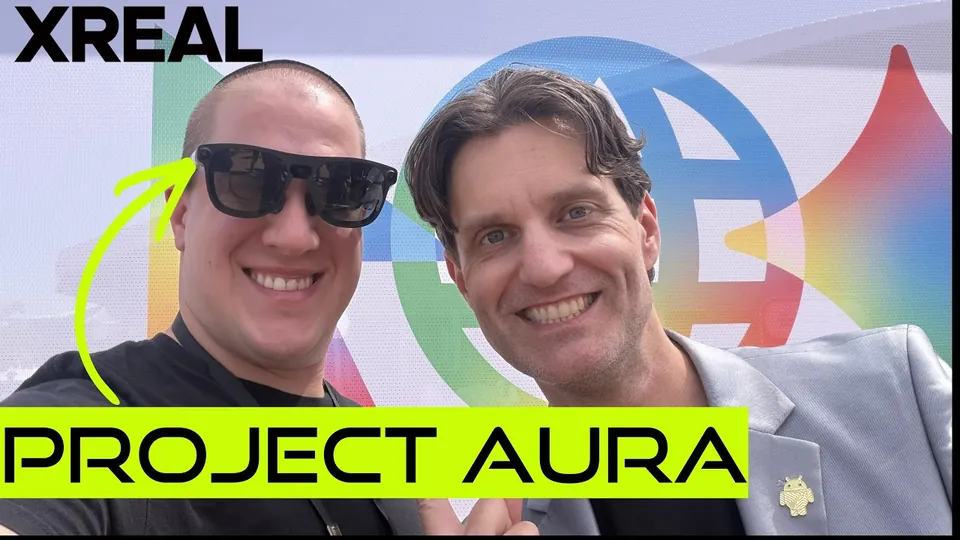
Prefer to watch? The full video is right here. 17:12 · Watch on YouTube
Jump to a section in the video
The Android XR Catalyst developer program
XREAL's main announcement was the Android XR Catalyst developer program. Applications are open on the Android developer site and at xreal.com/aura. Developers tell Google and XREAL what they want to build, both companies review it, and dev kits ship. Ralph said they will be shipping hundreds of dev kits, if not more, in the next couple of weeks.
I asked whether apps built for Samsung's Galaxy XR headset carry over. Ralph said there are options. Some run one to one: he is using Galaxy XR VR apps on Aura today. Some were clearly made for Galaxy and need a light lift and shift, and developers can also do a full remodel. Because it is Android XR, Aura can run VR, MR and AR experiences.
Desktop apps, XR apps and Gemini on your screen
For context, this is mostly an immersive experience like the Galaxy XR, but without the big light seals, so you do not get full blackout. I think that makes it far more approachable. I wore my Vision Pro on the flight to I/O and everybody around me was thinking, look at this idiot. I do it because I get my whole desktop in space.
My key question has always been whether I can have my desktop in virtual space alongside other XR apps. Ralph's answer was a resounding yes. He wore Aura on his flight with the puck on his tray table, plugged into his Microsoft Surface Laptop over DisplayPort. His full desktop sat in front of him, with Aura apps on both sides and one Gemini experience across all of it, on one 70 degree canvas. I confirmed with the team it also works with a Mac, and anything with DisplayPort, including PCs and Chromebooks.
“It is better than a massive face computer, Jesse.”
Gemini can see what you are connected to through the puck, whether that is your desktop, a game console or what you are watching in XR, and answer questions or take actions based on it. Ralph's example: plug the puck into a Steam Deck, get stuck on a level of Hollow Knight Silksong, and ask Gemini what to do. It looks at the screen, looks at the internet and tells you. Next time I am stuck in Tears of the Kingdom, I know who to call.
Gaze tracking, not eye tracking
A community question: Android XR does hand tracking, but what about eye tracking? Ralph's answer was simple: no. Aura has SLAM sensors in the corners and an RGB camera in front, but no sensor pointing back at your eyes. Instead it does gaze tracking using those front sensors, plus cursors, laser pointers, gestures and controllers.
So the look-and-select trick from Vision Pro and Galaxy XR is not here. I had been told otherwise at the booth, probably a mix-up about which device we meant, and Aniket from the team corrected me on X. Ralph's point is that eye tracking is magical and expensive, and Aura gets close at a fraction of the cost. The puck has a touchscreen trackpad, so you can control it the way you already use your phone, without waving your arms into the person next to you on a plane.
The puck: ports, fingerprint and a very smart clip
The puck has two USB-C ports on the bottom, one for charging and one for the glasses, a fingerprint sensor for authentication, and vents on top. There is no speaker on it; audio runs through the glasses. On battery, Ralph would not give a number because it depends on what you are doing. He credited the XREAL X1 chip in the glasses and the Qualcomm Snapdragon chipset in the puck, and said in internal testing it is more efficient than anything XREAL has made before. With the extra port, you can stay plugged in.
My favorite detail is the clip. The pucks for Galaxy XR and Vision Pro have no clip, and they constantly fall out of my pocket or slide off the bed. Ralph called no clip a recipe for falling and overheating. Aura's clip pops off, and you can swap in a lanyard, which is handy for location-based experiences or passing it around.
Flatter prisms, a 70 degree field of view, and availability
XREAL optics by generation
| Lens design | Field of view |
|---|---|
| Triangular birdbath | Up to 52 degrees |
| Flat prism, One Pro | 57 degrees |
| Flatter prism, Project Aura | 70 degrees |
As Ralph described it at Google I/O.
Aura uses a more advanced version of the flat prism lens in the One Pro. Ralph called it more for less: thinner, but bigger. The chassis and optics shrink while the field of view grows. Flattening those prisms has been a game changer for me. With the angled birdbath designs, anything white, like my badge or a white tabletop, caused constant glare at the top, and I do a lot of waiting room work. XREAL will keep selling birdbath models at different prices, but Ralph is clearly proud they got this thin without moving to waveguides yet.
The 70 degree field of view really does make you feel immersed, even without light blockers. In broad daylight in the demo tent, I played a tabletop board game demo and controlled it with my hands without a problem. And since it is optical see-through, with a built-in front camera, developers are also building MR and AR apps that place things in the real world.
This year. Ralph was clear the dev kit is 99% the same as the consumer model; the software is a little different so developers can do their thing. A real product name is coming. XREAL will share more on retail soon, but the plan is that you can try it on in stores and buy it there and online. And since it is Android, there are already a million Play Store apps you can run in XR space, plus a growing number built for XR.
Bottom line
This is a major unlock for the whole Android XR ecosystem. Aura looks like sunglasses, mirrors any DisplayPort device next to native XR apps, and brings Gemini along. No eye tracking and no battery number yet, but the clip alone shows XREAL is thinking about how people actually use these. I will show it off as soon as I can pry a set out of Ralph's hands.
Gear in this story
- XREAL Project Aura (Android XR Catalyst dev program)xreal.com (opens in a new tab)
Some of these store links are affiliate links. If you buy through them, the channel may get a small commission at no extra cost to you. Affiliate disclosure
Related stories
Hands-on with the new Meta Ray-Ban Gen 3: Aviators, a camera-free option and a smaller camera
Sep 25, 2026 · 4 min read
Unboxing XREAL Aura: Android XR in a case that fits your backpack
Jun 24, 2026 · 5 min read

XREAL's Project Aura, X1S chip, Neo battery and Enterprise push: my interview with Ralph
Jun 12, 2025 · 4 min read
Jesse Nowlin
Founder of TABGEEKS, former IT Director and Google Developer Expert. I test networking and pro tech on real job sites, then write up what I find.
Join the community