

RingConn Gen 3 review: a smart ring with no subscription
I wore the RingConn Gen 3 for about a week next to my Oura Ring 5. It tracks wellness with no subscription, and the charging case is in the box.

Jesse Nowlin
Founder, TABGEEKS · · 4 min read
This video is sponsored by RingConn. They sent me the RingConn Gen 3, their subscription-free alternative to the Oura, and I wore it for about a week next to my Oura Ring 5. I came away pleasantly surprised.
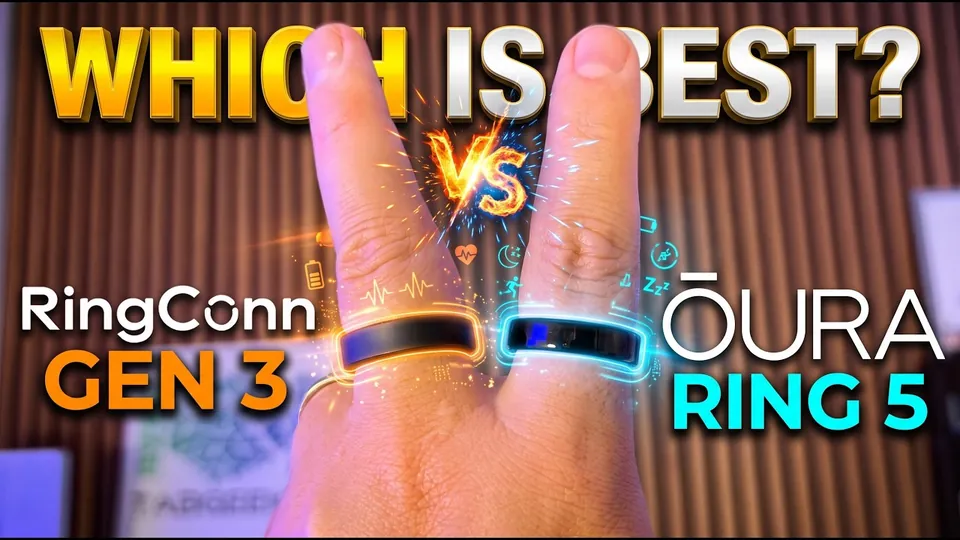
Prefer to watch? The full video is right here. 13:02 · Watch on YouTube
Jump to a section in the video
Why a ring and a watch
I have worn smart rings and smartwatches for a long time. When I bruised a rib roller skating, tracking my metrics helped me keep working out other parts of my body while I healed. I wear a ring as well as a watch because I cannot stand sleeping with a watch on my wrist. I did it in the military, it was miserable, and the Apple Watch Ultra I wear now is far bulkier. A ring does the sleep tracking without bothering me.
The ring on my other finger is not a health ring. It is an AI ring from Pebble that I press to talk to my AI agents. A health ring tracks your vitals, such as blood oxygen, heart rate, movement and even the kind of exercise you do, in a much smaller form factor than a watch.
Size and finish
Side by side, the RingConn Gen 3 sits between the Oura Ring 4 and Ring 5 in size, and it is comfortable enough that you forget it is there. I like that the RingConn has a matte finish, where the Oura is glossy. Oura does offer a matte option, but it costs roughly $150 extra on a ring that is already expensive and comes with a subscription. The RingConn has no subscription.
Sizing
Like the Oura, it ships with a sizing kit first, with sizes 6 through 14. I am a 12. Try them on, pick your size, then order the real ring. Sizing was accurate for me. The two small bumps inside the ring are sensor guides, so fit matters. With the Oura I ended up on a different finger than I first tried, but the RingConn fit well on the first one.
In the box
Besides the ring you get a quick-start guide and manual, though the app onboards you well, and a charging case, which the Oura did not include. There is a braided USB-C to USB-C cable, about 3 feet long. No charging brick is included.
The case has a built-in 500 mAh battery. It is small next to a phone, but for a ring it is enough to give up to 150 extra days of charge. Battery life on the ring itself is about a week, so if I am traveling longer I would normally need to bring the Oura's base. With the RingConn I just drop the ring in the case, close it, and the light on the front shows it charging. That is handy for hiking or anywhere without an outlet. The case alone is $80 in the store.
The app
One downside for now: the app is not optimized for the iPhone Duo yet. That goes for plenty of other apps too, and the Oura app is already updated, so on that point the comparison is not quite even.
The home screen is where you spend your time. A clover-leaf wellness balance shows how you did on sleep, vitals, relaxation and activity, and gives a daily tip. My activity score was a low 36, so yes, I should move more. I slept 7 hours and 6 minutes the night my kids woke me up. There is a stress index, which is fun to check with kids around, plus heart rate, blood oxygen at 96%, heart rate variability, respiratory rate and a temperature of 96.5.
My favorite part is the notes. In the Oura app you can only add tags like traveled or conference. In the RingConn app you can write real notes with detail, which helped me track an injury during recovery. I believe you can even ask their assistant to analyze them. You can look back day by day, and the ring settings tell you almost to the minute when the battery will die. Mine said to charge before 7:00 p.m. on November 10th, and I had not charged it once since I got it. There is also a Discover tab with tips and a lifestyle score, which measures how well your daily routine lines up with your circadian rhythm.
The vibration reminder
There is a vibration motor in this tiny ring, which the Oura does not have. If I have not stood up for an hour, it buzzes my finger to get up and walk around. It does not vibrate for notifications. My wife wore an Apple Watch for that reminder but does not like wearing a watch, so she is now considering the ring.
Compared with Oura
The Oura app is optimized for the iPhone Duo, so it runs wide screen. It also tracks my GLP-1 use, which I did not see in the RingConn app, and it syncs weight from my scale and Apple Health, which I also did not find in the RingConn app. But the metrics were accurate by comparison, and the RingConn held its own day by day against what I think of as the industry standard. In the RingConn column: it is cheaper, it needs no subscription, and it comes with the battery case.
Bottom line
If you want an affordable AI health ring, I recommend the RingConn Gen 3. It was a pleasant surprise. It costs $350, but for Black Friday RingConn is giving 10% off when you sign up with your email, from November 19th to the 30th. The link is in the description.
Gear in this story
- RingConn Gen 3bit.ly (opens in a new tab)
Some of these store links are affiliate links. If you buy through them, the channel may get a small commission at no extra cost to you. Affiliate disclosure
Related stories
I bought Apple's HomeView: setup, widgets, AirPlay and the missing Siri timer
Nov 17, 2026 · 5 min read
The best super thin iPhone Duo cases so far: ZAGG, ThinBorne, SmallRig, PITAKA and TORRAS
Nov 12, 2026 · 3 min read
First look: the thinner, lighter touchscreen MacBook Pro 14 with M5 Pro
Nov 8, 2026 · 5 min read
Jesse Nowlin
Founder of TABGEEKS, former IT Director and Google Developer Expert. I test networking and pro tech on real job sites, then write up what I find.
Join the community