

Palmer Luckey at AWE 2025: Eagle Eye, teaming up with Meta, and where XR came from
Onstage at AWE 2025, the Oculus and Anduril founder talked through his partnership with the company that fired him, the Eagle Eye platform for the US Army, and why battlefield AI has to work offline.

Jesse Nowlin
Founder, TABGEEKS · · 5 min read
Palmer Luckey started Oculus at 19, sold it to Facebook, and was fired in early 2017. So when his defense company, Anduril, announced it was teaming up with Meta to build combat heads-up displays for the US Army, a lot of people were surprised. At AWE 2025, he sat down onstage, with a voice nearly gone after ten days of meetings in Washington, D.C., to explain why.
The conversation covered the Meta partnership, the government roots of AR and VR, the Eagle Eye platform, how Anduril thinks about AI on the battlefield, and who will never get to buy it. Here is what stood out to me.
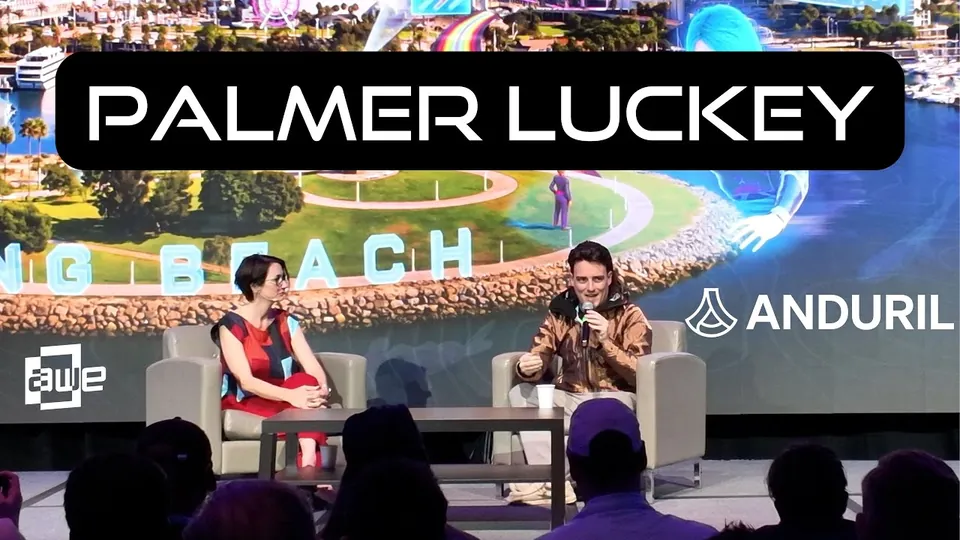
Prefer to watch? The full video is right here. 31:08 · Watch on YouTube
Jump to a section in the video
Why Anduril teamed up with Meta
Luckey's argument is that AR and VR used to be pushed largely by the government and military. That is where the funding and products were. Over the last few years, he says, the consumer space has taken the lead, and the best AR and VR tech is now mostly built by consumer and commercial companies like Meta.
Some of what he invented before selling Oculus, while he was there, and what Meta has invented since, is out of his toolbox unless he partners with them. He admits he has plenty of beefs in his life, but says that when the work is literally life and death, it is too important to let personal grudges stand in the way. Asked if it was just about getting his toys back, he answered that it was about getting his toys back for a good cause.
XR's government roots
The interviewer pointed out that much of the AR and VR funding in the '60s and '90s came from government, which was also a major customer. Luckey agreed. Right before Oculus, he worked at an Army affiliated research center on the Bravemind program, using immersive VR therapy to treat veterans with post-traumatic stress disorder. He noted that almost everyone in the AWE Hall of Fame worked on government funded programs.
He describes technology as a pendulum. Sometimes the consumer and commercial side leads. Then major government investment pushes the military ahead, and that investment trickles down, as with microprocessors, GPS, displays, aircraft and cars. Right now, he says, the Army desperately wants the tech that Meta, Snapchat and Google have built, and much of what Anduril builds on top of it will come back to consumers.
What Eagle Eye is
Eagle Eye is not one headset. Luckey calls it a platform for building visual augmentation systems, because a front-line infantryman needs a different field of view and ballistic rating than a logistician, aircraft maintainer or warehouse worker.
In a nutshell, it provides vision and hearing enhancement and an augmented view across the thermal, visible, near IR and hyperspectral spectrums. It also visualizes radio frequency and sound. It can highlight threats, show where your own people are, show a path to safety, handle ballistics calculations, and let you control large numbers of weapon systems. It includes a 360 degree threat awareness system that detects drone, vehicle and on-foot threats and categorizes them. The team includes Oakley, Meta and Qualcomm, with a powerful chunk of Qualcomm compute onboard.
Because the Army values performance over price, he says, they can build a headset that costs tens of thousands of dollars to make, with better image sensors than Apple would put in a Vision Pro and displays far beyond what the consumer market would bear. He couldn't share specs, because the customer doesn't want him to.
“Eagle Eye is going to be the best AR and VR device that's ever been made. It's not even close.”
He says it is several times the resolution and capability of the Apple Vision Pro. It is also a fully ballistic rated shell that is waterproof, heatproof and drop-proof.
Will any of it reach consumers?
Yes, but not from Anduril. Under the licensing agreement, Anduril deploys the co-developed tech to the military, and partners like Meta and Qualcomm take it back to consumer devices. He expects data transport layers, compression schemes, low-light sensor techniques and super resolution tech to make that trip. He also admitted to having his fingers crossed for a new Rift that pushes limits rather than aiming for the average buyer.
AI that works when comms break
The big difference from consumer AI, Luckey says, is that Anduril's models must run locally, on the soldier, submarine, fighter jet or vehicle. Communications often don't exist in the field, and an enemy can jam them or destroy a data center. He likes to cite the Trade Federation's battle droids, which stopped working when their central computer was destroyed.
He wants a guardian angel, not an assistant that does exactly what you ask. And it must surface its uncertainty. He told a story about asking ChatGPT to find a childhood book about VR. It returned five matches, and only one existed. Errors like that, he said, cannot come to the battlefield.
On ethics, he pointed out that the DoD has had guidance on autonomy for decades, and will accept sub-optimal outcomes on a statistical basis if it means a person is always making and taking responsibility.
Interfaces that get out of the way
Luckey says a lot of UI research comes from games and websites, where interaction is the point. Soldiers shouldn't have a full-time job running the interface or switching between thermal, night and visible modes. Superman, he notes, doesn't go through menus to use his heat vision.
“I want it to know what I'm trying to do and do it before I've even done it.”
The only explicit interactions should be where human accountability comes in. He doesn't want the robot launching weapons on its own, but he does want it watching for threats. He credits much of his career to copying science fiction, like the heads-up display in Robert Heinlein's 1959 novel Starship Troopers, and Cortana from Halo, not the Windows product.
Who will never buy it
Asked who his last customer would be, Luckey's first answer was adversarial nations, since selling to China today would send him to prison. That is also why Eagle Eye won't be sold to hunters or paintball players: anything sold to civilians eventually reaches adversaries. Anduril also needs to focus on one use case, so consumers will get the technology through partners. He closed on what he called a utopian note, hoping the world changes enough over 50 or 100 years that today's adversaries could become partners.
Bottom line
What I took from this is that the flow of XR tech has flipped. The best hardware now comes from consumer companies, defense is buying in, and if Luckey is right, the sensors, compression and low-light work in Eagle Eye will find their way back into the headsets and glasses the rest of us use.
Related stories
Hands-on with the new Meta Ray-Ban Gen 3: Aviators, a camera-free option and a smaller camera
Sep 25, 2026 · 4 min read
Unboxing XREAL Aura: Android XR in a case that fits your backpack
Jun 24, 2026 · 5 min read

XREAL's Project Aura, X1S chip, Neo battery and Enterprise push: my interview with Ralph
Jun 12, 2025 · 4 min read
Jesse Nowlin
Founder of TABGEEKS, former IT Director and Google Developer Expert. I test networking and pro tech on real job sites, then write up what I find.
Join the community