

Home / Stories / UniFi + Networking
UniFi Siren PoE and Environmental Sensor: SuperLink is finally rolling out
Six months after Ubiquiti announced SuperLink, the first two devices are here. I adopted the Environmental Sensor and the Siren PoE, wired the siren to a G6 Turret alarm and looked at what is coming next.

Jesse Nowlin
Founder, TABGEEKS · · 5 min read
No, you are not imagining it. Ubiquiti has finally released not one but two products in the new SuperLink family: the Environmental Sensor and the Siren PoE. We have been waiting since the announcement six months ago, and today is the start of the rollout.
Quick refresher: SuperLink is Ubiquiti's long range, low latency IoT platform. It is designed to be simple, built for commercial and residential use and integrated directly into UniFi. I have a SuperLink Gateway in my rack, so I adopted both devices, set up alarms and triggered the siren from a camera.
Prefer to watch? The full video is right here. 22:18 · Watch on YouTube
Jump to a section in the video
Environmental Sensor: tiny, IPX5 and a six year battery
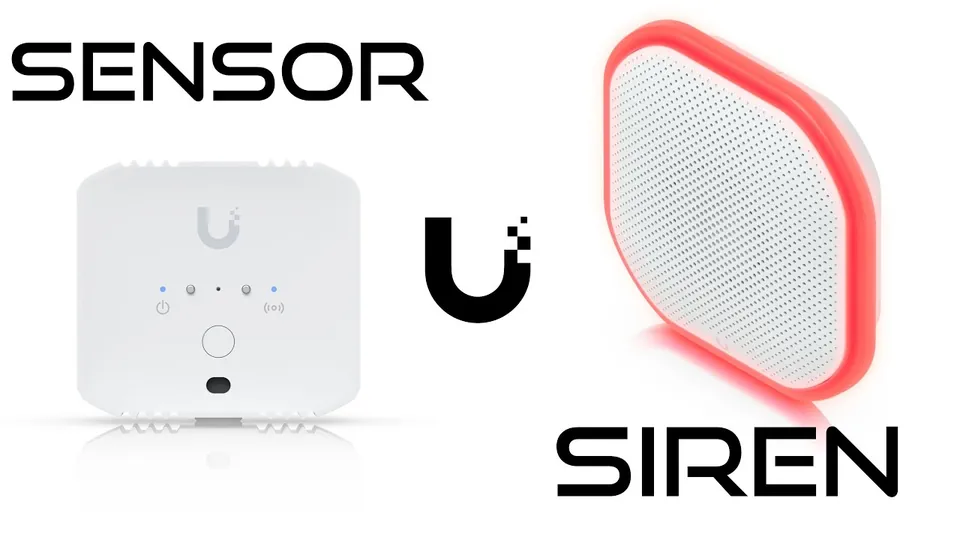
It is a tiny box with a tiny sensor inside, in polycarbonate with the same industrial design as the gateway. It is rated IPX5, which basically means it handles water short of immersion. The front has a status LED, a signal LED, an ambient light sensor, a function button and the temperature and humidity sensor. Two small metal contacts on the front detect water and moisture.
On the back is a reset button and a CR123A battery behind a double door. Under a rubber grommet on the bottom is a 3.5 mm jack for a water leak probe. Ubiquiti told me they are not making a first party leak probe, but they have tested it with the YoLink water leak sensors, the Mocreo SW2, the Eve Water Guard and the Moen Smart Leak Detector. Depending on your settings, Ubiquiti says the battery should last six years.
Adoption and settings
I pulled the battery tab and the sensor showed up in my dashboard instantly, ready to adopt. Right away it reported no leaks, 219 lux from my studio lights, 43 percent humidity and 81.7 degrees, which was probably my warm hands. Connection strength was minus 41 dBm, which makes sense with the gateway a few feet away. The left LED is white for ready to adopt, blue for adopted and red for low battery. The right LED is blue when connected and red when disconnected.
In settings you can name it, pair it with a camera, tag it, choose which events to capture and set safe zones. You can set the update frequency, but more frequent updates burn more battery. Like an AP, you can lock it to a specific SuperLink Gateway. Tapping the function button wakes the sensor for an instant reading. In the Alarm Manager you can trigger on extreme values or a leak, then notify, unlock, turn on a light, move a camera or sound the AI Horn or the new siren.
Siren PoE: loud, bright and weatherproof
The Siren PoE is an all-weather siren for a wall or ceiling. That is all it does. Unlike the AI Horn, it doesn't play audio files, just the siren. It is rated at 110 dB. On the back is a tamper sensor, a solid Ethernet gland, a cable track and a cap, plus a T8 security screw to keep it in place. It is rated IP56 for outdoor use, and an RGBW LED ring around it works as emergency lighting and draws attention.
I plugged it into my XG desktop switch for power and it showed up ready to adopt. Locate makes the ring flash a very bright blue. In settings you get name, max volume, manual recovery, locate, restart and remove.
The first two SuperLink devices
| Environmental Sensor | Siren PoE | |
|---|---|---|
| Price | $49 | $109 |
| Power | CR123A, rated up to 6 years | PoE |
| Rating | IPX5 | IP56 |
| Senses or does | Temperature, humidity, light, water | 110 dB siren, RGBW LED ring |
| Extras | 3.5 mm leak probe jack, magnetic mount | Tamper sensor, T8 security screw |
Prices and specs as stated in the video.
Testing the siren with a G6 Turret
I turned the max volume down to 10 percent and used my Apple Watch as a rough decibel meter. Talking loudly read 82 dB and silence 36 dB. At 10 percent the siren read 90 dB, flashing red. At 20 percent it read 100 dB. Watch readings right next to the speaker aren't how ratings are measured, so take those as a feel for it, not a spec. Needless to say, it is really loud.
The magic is pairing it with other devices. On my G6 Turret I have a line crossing zone for someone leaving the sidewalk and heading toward the house. In the Alarm Manager I created an alarm: when someone crosses that line, sound the Siren PoE for 30 seconds and notify all admins. Then I walked outside and crossed the line. It went off, and I should have been wearing earplugs. The event showed as triggered with the clip from the G6 Turret.
“I think this is a massive next stage for Ubiquiti branching out into this area.”
What is in the box
The siren ships with a protective cap over the front, like Ubiquiti's APs, so you don't smudge it while mounting. You also get a mounting template, three bags of screws, a T8 driver and three sizes of cable gland to keep it waterproof. The sensor comes with a template, screws and anchors and a metal plate with adhesive on the back. The plate mounts to the wall and the sensor attaches to it magnetically.
The rest of the SuperLink family
From what Ubiquiti has shown so far, still to come are a glass break sensor, a fob, a smoke detector, an alarm hub, a relay, an entry sensor, a motion sensor, an air quality sensor and an alarm control button for arming and disarming. I am most curious about the fob, the alarm control and the smoke detector. I would love an air quality sensor that pings my phone when the studio gets stuffy.
Yes, people pushed back on another proprietary protocol. But IoT is hard. Zigbee, Z-Wave, Thread and Matter agree on some things and not others. If you already run Ubiquiti Wi-Fi, networking, cameras and access control, a walled garden makes a lot of sense, especially for business, where easy smart systems mostly don't exist.
Bottom line
At $49 for the Environmental Sensor and $109 for the Siren PoE, both available now, these are excellent price points and solid first steps for SuperLink. Setup was smooth, even though the quick start guide just pointed to the website. I am saving the range test for a follow-up at an industrial client site, where I tested the original SuperLink Gateway.
Gear in this story
- Environmental SensorSpecs and compare for Environmental SensorUbiquiti Store (opens in a new tab)
- Siren PoESpecs and compare for Siren PoEUbiquiti Store (opens in a new tab)
- SuperLink GatewaySpecs and compare for SuperLink GatewayUbiquiti Store (opens in a new tab)
- Camera G6 TurretSpecs and compare for Camera G6 TurretUbiquiti Store (opens in a new tab)
- YoLink water leak sensorAmazon (opens in a new tab)
- Mocreo SW2 leak sensorAmazon (opens in a new tab)
- Eve Water GuardAmazon (opens in a new tab)
- Moen Smart Leak DetectorAmazon (opens in a new tab)
Some of these store links are affiliate links. If you buy through them, the channel may get a small commission at no extra cost to you. Affiliate disclosure
Related stories
UniFi SuperLink: Ubiquiti's IoT future, tested in a craft brewery
Feb 11, 2025 · 4 min read
UniFi G6 Bullet, Turret and Instant review: 4K across the board, tested against G5, G4 and AI Pro
Mar 24, 2025 · 6 min read
UniFi AI Port: adding face and plate recognition to older cameras
Dec 12, 2024 · 4 min read
Jesse Nowlin
Founder of TABGEEKS, former IT Director and Google Developer Expert. I test networking and pro tech on real job sites, then write up what I find.
Join the community