

Home / Stories / AI at work
Google, we're breaking up: why Notion became my AI assistant workspace
Gemini's million-token context window got me part of the way to a real AI assistant. Memory is what was missing, and Notion's agents are what finally gave it to me.

Jesse Nowlin
Founder, TABGEEKS · · 5 min read
Like a lot of you, I have this dream of the perfect AI assistant: always on, contextually aware, knows everything about me, and actually able to get things done. Basically Jarvis from Iron Man. We are nowhere close to that yet. The thing standing in the way isn't intelligence. It is memory.
I have been trying to get there with Gemini ever since it got its million-token context window, and it worked, somewhat. But the gaps kept costing me time, and I have started moving, I hate to say it, away from Google for this. My second brain and my agents now live in Notion. Here is why, how I set it up, and what Google needs to fix.
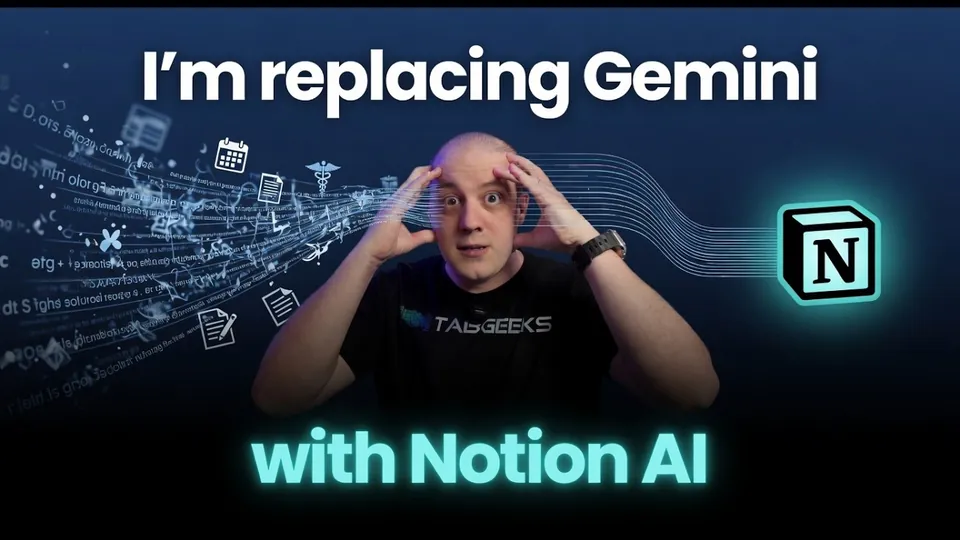
Prefer to watch? The full video is right here. 14:37 · Watch on YouTube
Jump to a section in the video
How I tried to build Jarvis with Gemini
A million tokens is an enormous amount of information. Most conversations use only handfuls of tokens unless you upload something big like a large PDF. Based on how I use it, I estimated a million tokens would last approximately 6 to 9 months of conversations before it starts forgetting.
So I split my life into separate pinned chats in Gemini, each acting as its own agent: work, home, medical management, and a nonprofit whose board I sit on. Each started with a master prompt: you are my work assistant, it is your job to help me remember things, I am going to throw a lot of information at you, help me organize it. One of my key prompt hacks was adding "ask me clarifying questions," which turns it into a real conversation.
Where Gemini falls short: memory and the context tax
The limits showed up fast. You get rate-limited and run out for the day. Or the chat starts forgetting things from the very beginning, including the master prompt, and it is time to restart. I am hitting that point with some of my agents now.
The bigger problem is what I call the context tax. Google Meet takes fantastic meeting notes, but then I have to move them into Drive and tell the agent to look at them. If something comes in by email, I have to tell the agent to go find it. The agent should just know all of this. Without memory, an assistant isn't much more useful than a regular Google search, even with everything Google knows about us.
To be fair, I am using Gemini in a paid Google Workspace instance, because that is where TABGEEKS operates, and that may be part of the issue. Google probably hasn't released memory features there yet because it is still working out how that fits with things like HIPAA compliance and huge organizations of data.
Notion as a black hole for my information
I have been on and off with Notion over the years, and then I discovered it added AI agents. Not one agent, a team of them, using all of your Notion data as context. More importantly, they have memory, because the memory is everything stored in Notion. Set it up correctly and you have pretty much unlimited storage for what your agent needs to know.
I no longer need one agent per topic. I talk to one agent and say I need this thing for this project. It knows where the project is and where to find it. Notion's meeting notes tool is also fantastic, rivaling Google Meet's, which I have long said is the best in the industry.
“The greatest thing about Notion is also the worst thing about Notion.”
It is infinitely customizable, which also makes it incredibly complex. If you don't know how to structure it, you will be overwhelmed straight out of the gate. And my own problem with productivity systems is that I spend all my time building the perfect system, then get busy and stop using it.
AI fixes that. Everything I have falls into four pillars: home, work, my nonprofit, and medical management. I set up those four inside Notion with a back end. Once that exists, Notion becomes a black hole. I write down daily tasks, I journal, I type information into the bot, and it puts it away. When I need it later, I just ask.
The workflow that sold me
Notion isn't one AI model. It has an auto model picker that chooses between Gemini, ChatGPT, Claude and others based on the cost and complexity of the query.
The moment it clicked was this video. While driving, I talked to my agent and told it to create a new task in my production area called "Google, we're breaking up," with a description of what I wanted to cover. It found my production page, created a new entry in that database using the format set up in the agent's instructions, gave it the title, and then went further. It expanded my rambling into bullets and paragraphs laid out as video notes.
I don't use scripts or a teleprompter. I record from bullet points. So from one voice prompt in the car, I had nearly finished show notes. I can also add a due date, urgency and how much energy a video will take, and it puts each detail in the right field.
What Google needs to fix
Still, in 2026, Google has a terrible implementation of task management. I am a one-man show, and Google Tasks doesn't cut it even for me. We have moved past running tasks in a Google Sheet. I wish Google had just bought Notion or Asana or Monday.
Google is getting there. It has my Drive, my Gmail, my Chrome bookmarks and my Gemini conversations, and Gemini is a phenomenal model. Memory features are starting to appear on the consumer side. But on the Google side, my agent doesn't know something exists unless I tell it, and I have to know what it is called. In Notion I can control what the agent can access, down to specific pages, and otherwise I just talk and it happens.
Bottom line
My Notion setup isn't perfect, and it is still a work in progress, with three of the four pillars set up. But it is a working, context-aware assistant that takes in everything and hands it back when I ask. For someone as busy and all over the place as I am, that is critical. I plan to turn it into a template and show the full setup.
We will get to Jarvis. Agents are going to be everywhere for the next year or two or three, starting with business and bleeding down into consumer, from Chrome's ability to act on web pages, which grew out of Project Mariner at last year's I/O, to tools like OpenClaw. Right now, though, Notion has nailed it. Google, I hope you're taking notes.
Gear in this story
Some of these store links are affiliate links. If you buy through them, the channel may get a small commission at no extra cost to you. Affiliate disclosure
Related stories
Shadow IT on steroids: how to govern AI agents at work
Oct 7, 2026 · 7 min read
Your IT stack is bloated: how to simplify and secure it for 2026, with Promevo's Colin McCarthy
Dec 2, 2025 · 7 min read
What is Meta Muse? A week with Meta's new personal AI agent
Sep 23, 2026 · 6 min read
Jesse Nowlin
Founder of TABGEEKS, former IT Director and Google Developer Expert. I test networking and pro tech on real job sites, then write up what I find.
Join the community