

Home / Stories / AI at work
Shadow IT on steroids: how to govern AI agents at work
Everyone wants AI agents yesterday. Promevo CTO John Pettit and I walk through what it takes to roll them out without losing control of your data, identity or budget.

Jesse Nowlin
Founder, TABGEEKS · · 7 min read
It is a strange moment for AI. On one side there are whistleblowers and real concern about where this is all heading. On the other, every business I talk to is saying the same thing: we need AI, we need agents, how do we start? I have been testing agents in my own operations as a solo builder and they have blown me away.
So I brought the Promevo team back, this time with John Pettit, their CTO, to talk about the whole picture: what has to be in place before you connect agents to company data, how shadow IT gets worse when anyone can build an app, and how to keep hundreds or thousands of agents under control once they are running. The short answer: it all starts with identity and groups, and the basics haven't changed. They are just on an accelerated timeline.
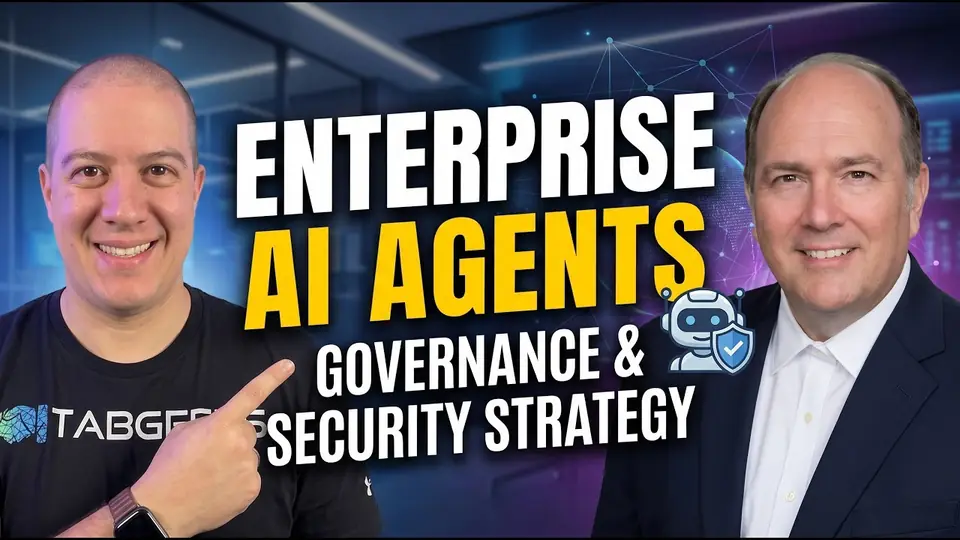
Prefer to watch? The full video is right here. 37:05 · Watch on YouTube
Jump to a section in the video
AI is an amplifier, including of failure
John described two tension points inside most organizations. The board and executives want AI for the productivity gains it promises. The admin tier is asking how to do it without exposing the company to risk, and without losing their own jobs if something goes wrong. The tooling to govern AI is still immature, so it is hard to see who is building what or what it will cost.
“AI is just an amplifier. So this is just amplifying the impacts of what you saw in the past.”
He pointed out that digital transformations have historically had about an 80% failure rate, and agentic transformations can be even higher if you haven't thought about the impact on your people, your technology and how you manage it after it goes live.
AI will find your overshared data
In my past life as an IT manager and IT director, especially through COVID, we did a lot of things very quickly with very little tracking. So my question to John was whether you can just point agents at decades of data and let them sort it out.
His answer: plugging AI into organizational data creates a fast lane to governance, because you immediately discover what is over-permissioned. AI is going to index everything and make it available, including the hidden sheets people have been emailing around for years. Group permissions, Drive shares, content labels and confidential data all come into play.
That is true whether you use Gemini Enterprise or hand out Claude to employees, because once you connect a tool to your drive storage through an MCP server or extension, all of that data is in reach. The organizations doing this well take the time first to identify and index their data types, audit groups and group permissions, and do some cleanup before rolling AI out.
Citizen development is shadow IT on a whole new level
The other shift is citizen development. It used to mean someone with Power Apps or some Apps Script. Now people build full applications without any insight into the libraries or tech stack involved. They just know it works, and they publish it. As I put it, this takes the shadow IT term to a whole new level.
Every CIO and head of IT John talks to says they needed visibility into what people are building yesterday. And that is just the tools they handed out, never mind the ones people signed up for on their own. Shutting it all off isn't the answer either. You can't be draconian and anti-competitive about it, but you are still responsible for your data.
His approach is a citizen development registry: a clean path to publish an app, a record of what exists and who owns it, and a standard delivery process that checks it against your security policies and lands it somewhere secure.
A starting playbook
The normal transformation playbook, where everyone stops while you make a plan, is out of date. People are already using AI at home and want it at work. John's starting sequence:
Where to start, as described in the video
| Step | What it means |
|---|---|
| Audit third-party app use | Find where corporate identity is used on apps that aren't approved |
| Assess and classify data | Work out what is available and what needs to be partitioned and protected |
| Pick the high-value data | Decide which enterprise data would make the organization "superpowered" if AI could use it |
| Build the data foundation | Connectors or a data lake, with data shaped so AI can use it well |
| Enable building | No-code and custom agents using the tools you approved |
| Change management | Communicate, give access and a reason to use the approved tools |
Managing agent sprawl and real ROI
Once this succeeds, John said, you can end up with hundreds or thousands of agents that are critical to your operations. You have to care about them almost like apps or employees. Are they working or failing? Who owns each one? Which departments does it affect? Which ones run on models reaching end of life? Which ones burn the most tokens?
ROI also needs to be real, not hand-waving about saving $1,000 every run. His example was a large manufacturer whose agent pulls supply chain data from SAP to flag where they will run short on parts. Before, they reacted on the fly and paid for expedited shipping, which he put at 5 million a year that the agent is helping them avoid. Different agents have very different ROI profiles, and you need to track and roll that up.
He also warned that if your internal debate is about which chatbot people prefer, you may have lost the plot. Power users will probably sit in Claude for coding, but for the other 80% of employees you want one clear, secure way to succeed with AI and the data they need. That is where he sees Gemini Enterprise having a platform edge.
How the Google stack fits together
John laid out the layers in a Google shop. Google Workspace is the base. Promevo's gPanel handles identity and access cleanup and governance over Drive. Gemini Enterprise is the AI platform. Promevo Insights sits on top for monitoring who is using which agents and what is happening in them.
One thing I learned last time is that Gemini Enterprise sits on the GCP side, not the Workspace side, and those permission models are not the same. John explained that clean Workspace groups can flow naturally into GCP roles and groups, so you aren't adding people to GCP on the fly. Gemini Enterprise runs in GCP partly because it doesn't require Workspace at all. It can sit on top of other identity providers and connectors, including data in Dropbox.
Auditing matters too. I learned this the hard way. I gave one of my agents too much leeway replying to emails from companies offering products to review. It agreed to one of them, handed over my shipping details, and a product I didn't want to review showed up at my door. Agent logs are exactly where that kind of risk should get flagged.
Redacting sensitive data with Model Armor
Regulated settings need more than rejection. With HIPAA or PCI data, you don't want credit card numbers living in chat history. Google's Model Armor sits on top of Gemini Enterprise and can redact information as the response streams, so even with over-provisioned access, someone outside finance asking about payroll gets the sensitive parts stripped out.
One of my clients had 40 years of data where Social Security numbers ended up in phone number fields and license numbers in text fields in an old ERP. John said Model Armor has 170 or more built-in patterns you can switch on for blanket redaction. And because it is built on Google's Sensitive Data Protection service, you can also dump CRM data, scrub it and put it back as a normal data process.
Access starts with identity and groups. If you need finer control, you can give groups their own Gemini Enterprise portal behind one smart router, so everyone uses the same URL but lands in a portal with its own connectors and Model Armor rules. Lifecycle management keeps it honest: onboarding, offboarding and role changes should cascade through every system automatically.
Cutting agent cost
Insights tracks failing agents, thumbs-down ratings, cost and usage, so you can retire agents nobody uses and consolidate ones doing the same job. On architecture, John recommended a planner and worker approach: a smarter planner holds most of the context and passes small context to cheaper worker agents. It is often way cheaper with the same fidelity.
Bottom line
John's advice for overwhelmed organizations is back to basics. Assess where you are on governance and identity cleanup, or bring in a partner to do the assessment. Run a hackathon with subject matter experts to find the agents that will matter most, so you roll out a solution instead of just a tool. Then clean up, roll out and manage the change. He also noted that Google offers funding programs through partners for pilots and deployments. It is the same work we have always done in IT, just faster.
Related stories
Your IT stack is bloated: how to simplify and secure it for 2026, with Promevo's Colin McCarthy
Dec 2, 2025 · 7 min read
Google Beam, aka Project Starline: 3D video calls without a headset
Apr 25, 2025 · 4 min read
What is Meta Muse? A week with Meta's new personal AI agent
Sep 23, 2026 · 6 min read
Jesse Nowlin
Founder of TABGEEKS, former IT Director and Google Developer Expert. I test networking and pro tech on real job sites, then write up what I find.
Join the community