

Home / Stories / AI at work
Inside Google Cloud Next: robot camera crews, new TPUs, quantum chips and a crash
My tenth Google Cloud Next started days early with the GDE Summit, NAB and the Sphere, and ended with new TPUs, a 105-qubit quantum chip and a robot dog camera operator. Somewhere in the middle, I crashed hard.

Jesse Nowlin
Founder, TABGEEKS · · 5 min read
Another year, another Google Cloud Next in Las Vegas, and this was my tenth. As a Google Developer Expert I got there days early, so by the time the first keynote started I had already done two days of 12-hour briefings, a trip to the NAB Show and a special event at the Sphere. I was losing my voice before the show even began.
This is my behind-the-scenes look at the week: the pre-show marathon, the keynotes, the best demos on the floor, including Google's new TPUs, the Willow quantum chip and a Boston Dynamics Spot running a cinema camera, and what I think the big takeaway is.
The short version: last year, AI agents felt like a tease. This year, they're actually here.
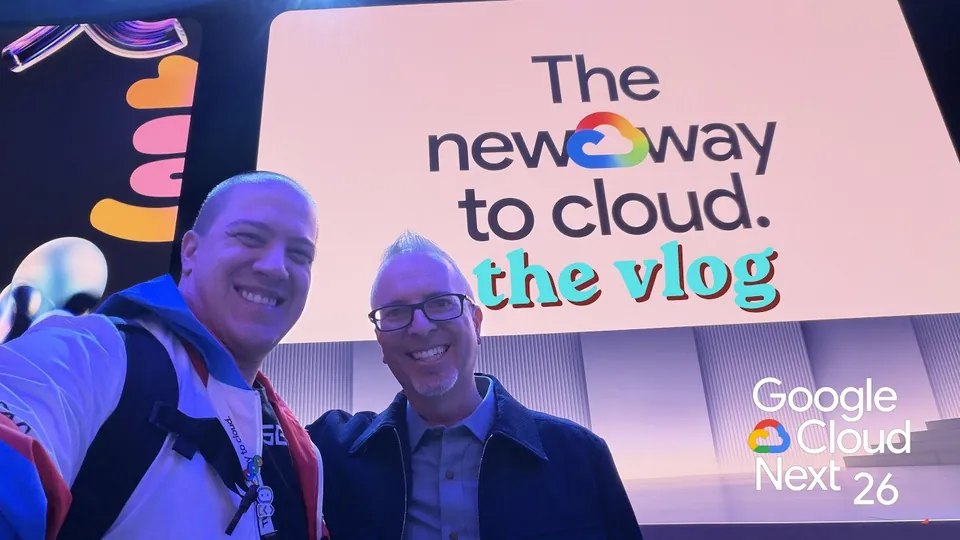
Prefer to watch? The full video is right here. 25:15 · Watch on YouTube
Jump to a section in the video
The pre-show marathon
It started with the GDE Summit. Most of it is under NDA, but we heard from program leads and the people behind the products, met GDEs from around the world, got some very cool jackets and even met legends like Logan Kilpatrick.
Then I ran over to NAB, the National Association of Broadcasters show at the Las Vegas Convention Center, which is basically all broadcast camera tech, microphones, live production and networks. I was nerding out. Google had a booth showing how its generative AI tools can help people in that industry. DJI, Insta360 and Ubiquiti were there too.
I hauled back across town to the Sphere for The Wizard of Oz, arriving 45 minutes late with 38 minutes left. My video on it last year got almost 400,000 views. Google used Gemini to extrapolate the original footage out to fill the massive Sphere, and it's as cool as it was the first time.
A preview of Google's AI infrastructure
That night, at the Formula 1 experience in Las Vegas, Google held an exclusive future of AI infrastructure event for press and analysts. Amin Vahdat, Google's VP of infrastructure, briefed us on the new TPUs ahead of the keynote. Being in that room was a privilege and a delight.
Day one, and the crash
Day one opened in the Michelob arena with about 10,000 people. GDEs get in early, so I was front row filming in 4K. A couple of years ago the Wi-Fi died during the keynote, and I was the only one with a 4K recording afterward. Being overprepared pays off.
As usual, Google dropped the news before the market opened, but I avoid reading it so I can get caught up in the energy. The message from the stage: a year ago, Google promised a bright future for AI, and today that future is running in production at a scale the world has never seen.
After the keynote and a meetup, I crashed. I found myself in the GDE certification lounge staring at my phone, and the screen wasn't even on. I needed sleep.
“We started out on Sunday night. So, we had 2 days of 12-hour briefings, and then we had the first day of Next, and I was just done.”
Day two: the developer keynote and AI-made cappuccinos
With sleep and coffee, day two started with the developer keynote, run by Richard Seroter, one of the best live presenters I've ever seen.
Then the best coffee line on the show floor. The app, built with Flutter and Firebase, has you work with Gemini and Nano Banana to create an image of your personal happy place, then tweak it with questions Gemini generates. World-class baristas make your cappuccino, and the image gets printed on top in edible ink. A good cappuccino on a conference floor is practically unheard of.
A robot dog camera crew
Perry from WPP, which runs creative R&D at one of the largest marketing services organizations in the world, showed me a Boston Dynamics Spot carrying a Sony split-body cinema camera, the kind used on the F1 film and the Top Gun films. The sensor separates from the body, which lets Spot move it smoothly. WPP has been using it to film Google's TPUs and servers.
Why Spot? It gets into enclosed, constrained spaces like labs, where robot arms can't, and it can repeat the same shot over and over. To smooth the arm, they use reinforcement learning, rewarding Spot in simulation for smooth motion. A simulation run used to take 11 hours. On Google's G4 server with eight RTX 6000 GPUs, a full run takes about 40 minutes, which matters when you're making lots of tiny adjustments.
Custom silicon: Axion, TPU 8t, TPU 8i and Willow
At the custom silicon booth, a product manager walked me through the hardware. Axion is Google's Arm-based processor for general purpose workloads, also used as the host for TPU systems. The eighth-generation TPUs come in two flavors.
Google's new chips, as described at the booth
| Chip | What it's for | Key details |
|---|---|---|
| TPU 8t | Training, built with LLM training in mind | 9,600 chips per pod, 3x the performance of the previous generation, 3D torus networking |
| TPU 8i | Serving, including sampling and reinforcement learning | 3x the SRAM, new networking topology that cuts latency |
| Axion | General purpose, and TPU host | Arm-based |
| Willow | Quantum computing | 105 qubits |
As described on the show floor at Google Cloud Next 2026.
Willow was the showstopper. What Willow can process in 5 minutes would take a current supercomputer 10 septillion years, which is 10 to the power of 25 years.
The takeaway
After a Workspace pool party and a concert with Weezer, which I grew up listening to, it was time to head home. My biggest takeaway: last year was a lot of "here's what's possible, the good stuff is coming." This year it feels like we're actually there. More companies offer interoperability, data moves across platforms and standards are being put in place. It feels a lot less janky.
Bottom line
A lot of people aren't fully aware of what's happening in AI, but business is changing to the point where it will never be the same. Agents are about to be everywhere, in consumer and in business. This was the best Next Google has ever done, and I've been to all of them.
Related stories
Shadow IT on steroids: how to govern AI agents at work
Oct 7, 2026 · 7 min read
Your IT stack is bloated: how to simplify and secure it for 2026, with Promevo's Colin McCarthy
Dec 2, 2025 · 7 min read
What is Meta Muse? A week with Meta's new personal AI agent
Sep 23, 2026 · 6 min read
Jesse Nowlin
Founder of TABGEEKS, former IT Director and Google Developer Expert. I test networking and pro tech on real job sites, then write up what I find.
Join the community