

Home / Stories / AI at work
Google Beam, aka Project Starline: 3D video calls without a headset
On the Google Cloud Next show floor, I sat down with Googler David Rosenthal, go-to-market lead for Project Starline, now Google Beam, to talk launch timing, HP hardware, Google Meet and Zoom, and who it is really for.

Jesse Nowlin
Founder, TABGEEKS · · 4 min read
I tried Project Starline at Google Cloud Next, and honestly, it cannot come soon enough. You sit down in what looks like a standard video conferencing setup, the call starts and the person across from you appears in 3D, with no headset and no glasses. At one point they went to hand me an apple, and I instinctively reached out to take it.
To find out where this is going, I talked with Googler David Rosenthal, the go-to-market lead for Starline, which Google has since rebranded as Google Beam. We covered how it started, when it launches, why HP builds the hardware, what it runs on and who Google expects to buy it first.
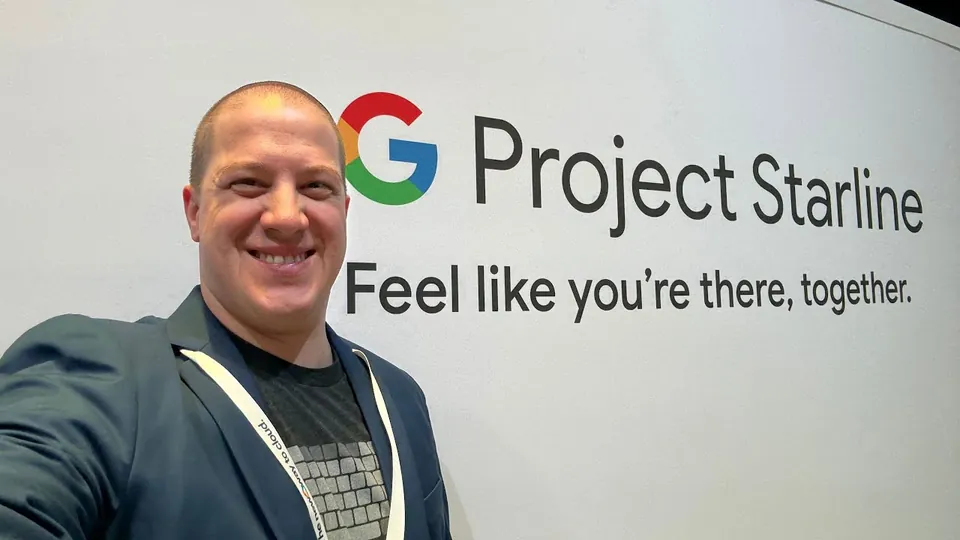
Prefer to watch? The full video is right here. 17:46 · Watch on YouTube
Jump to a section in the video
What Starline is, and what it isn't
Starline has come out of Google Labs over the past four or five years. It started as an experiment and is Google's foray into three-dimensional video conferencing. So is it a Star Trek hologram? David was clear: definitely not a hologram. He couldn't get into the underlying tech, but what you see is what your brain reads as a three-dimensional, full-motion image, with no headset.
It started with the team that did Google Glass, and the first version was a headset. Everyone loved it except for the headset. Removing it took a lot of math, a lot of science, some money and a lot of very smart people. The project is also very under wraps. I wasn't allowed to film my session, though David promised the gloves come off once the hardware is revealed.
“The first rule about Project Starline is you don't talk about Project Starline.”
Launch timing, HP and Google Meet
At the time of this interview, David said Starline would launch in the second half of 2025, with an announcement soon covering launch date, pricing, availability and regions. It is purpose-built hardware plus software. HP is the manufacturing partner for the first device and handles hardware and distribution, while Google provides the cloud software that does the 3D rendering.
My booth demo looked like a whole closet, so I asked whether I would need one in my conference room. No. Google is targeting existing small and medium conference rooms. It is a one-to-one experience, so it doesn't belong in a large room. At launch it runs on Google Meet for Workspace customers, and Google previously announced Starline will come to Zoom sometime after the first device ships. David credited COVID for ending the era when video platforms were islands.
What it felt like
You walk into a booth and sit down as if for a one-on-one at a desk. At first it is just a screen. Then the call starts, and the person looks like they are sitting across from you, not on a flat panel. You know the apple isn't there, because you walked in and saw an empty room, and you still reach for it. David said that challenges the idea that video can't be as good as real life.
It isn't perfect. I use XREAL glasses as a travel monitor, and even those still look a little grainy, like an older phone where you can see the pixels. Starline had a bit of that too. It is still very early, and Google's goal is to keep making it closer to real life.
I want it in my laptop. Kinect depth tech once filled an Xbox accessory and now powers Face ID. David couldn't say when Starline shrinks that far, citing raw material limits, but noted that HP and Dell are bringing next generation 3D monitors to market, so the pieces may come together.
Who will buy it first
Google sees a few launch use cases. First is executive communication: CEO to SVP, CEO to board, private equity and venture capital, the high stakes conversations. Second is people operations and HR, because a bad hire costs more than a good one pays back. That covers recruiting, interviewing, onboarding and even letting people go. Then there is general video conferencing in small rooms.
Beyond that are the unknowns. A hospital cart is a stretch technically, but mental health and telehealth seem like a fit, since some people don't want an emotional conversation with their therapist on a pixelated screen. It could help hiring committees with candidates who interview badly on video but great in person. I pictured shared office spaces full of booths for interviews, and David imagined Starline on a trailer at graduation day on campus.
Why HP
David gave a few reasons. HP is very good at manufacturing. Thanks to the Poly acquisition, it is excellent at audio, and bad audio ruins a meeting faster than mediocre video. It has a strong channel program from its video bar business, and it is a key Chromebook partner. David is on his first Chromebook, an HP Dragonfly, and I love the Dragonfly too.
If you want to try it, Google planned to bring demos to cloud summits, mostly in Europe, to InfoComm and to most large Google events. Stop by the booth and sign up.
Bottom line
Starline, now Google Beam, is the first video call tech that made me forget I was on one. It is early and a little grainy, it is aimed at executives and HR before everyone else and it needs its own hardware from HP. But the human connection is real, and that is exactly what we were all desperate for during COVID. Google comped my ticket to Cloud Next but did not pay me to discuss Starline.
Gear in this story
- DJI Osmo Pocket 3Amazon (opens in a new tab)
- DJI Mic 2Amazon (opens in a new tab)
Some of these store links are affiliate links. If you buy through them, the channel may get a small commission at no extra cost to you. Affiliate disclosure
Related stories

Shadow IT on steroids: how to govern AI agents at work
Oct 7, 2026 · 7 min read
Your IT stack is bloated: how to simplify and secure it for 2026, with Promevo's Colin McCarthy
Dec 2, 2025 · 7 min read
What is Meta Muse? A week with Meta's new personal AI agent
Sep 23, 2026 · 6 min read
Jesse Nowlin
Founder of TABGEEKS, former IT Director and Google Developer Expert. I test networking and pro tech on real job sites, then write up what I find.
Join the community