

Home / Stories / AI at work
How Google AI reimagined The Wizard of Oz for the Las Vegas Sphere
At the kickoff of Google Cloud Next, Google and Sphere showed how they used AI to take a 1939 film shot in 4:3 and expand it to fill the Sphere's massive 16K screen. Here's how they say they did it.

Jesse Nowlin
Founder, TABGEEKS · · 3 min read
I walked out of the Sphere saying it was incredible, and I meant it. To kick off Google Cloud Next, Google took the wraps off what it has been building with Warner Bros., Sphere, Google Cloud and the DeepMind AI teams: an unbelievable restoration and expansion of The Wizard of Oz.
To be clear, it's not an expansion of the story. The Wizard of Oz was filmed in 1939 in the small 4:3 format, and there's nothing beyond that original frame. Put that on a screen the size of the Sphere and you get heads cut off, bodies cut off, no feet and no characters outside the shot. AI is being used to fill in those gaps.
I recorded the behind-the-scenes presentation, which was hosted by Google CEO Sundar Pichai. Here's how the teams explained what they did.
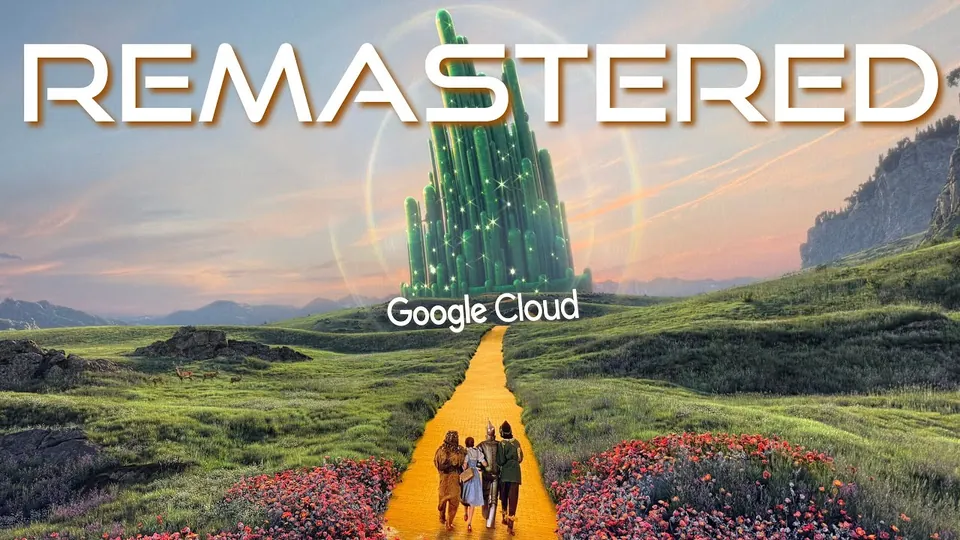
Prefer to watch? The full video is right here. 32:43 · Watch on YouTube
Jump to a section in the video
Why you can't just stretch a 1939 film
The challenge is format. The Sphere is a 16K immersive screen. The original film is a 4:3 image. As the Sphere team put it, they had to figure out how to adapt that 4:3 image, spread it across the screen and take you to another world, and getting that immersive experience off the ground had 10,000 moving parts.
Google's pitch for why it was suited to this: it's a company full of engineers, problem solvers and movie buffs, and over the last year its frontier models, including Gemini and its media generation model Veo 2, can do things that weren't possible with AI even 12 months earlier.
Three problems to solve
The team broke the work into three problems. First, they had to add and restore more detail than existed in the original film. Second, they had to complete characters who were cut off outside the original field of view. Third, with a much wider view, characters who should be there but were never captured on camera now needed to appear.
The three AI techniques, as described
| Problem | Technique | What it does |
|---|---|---|
| Not enough detail | Super resolution | Adds real detail and nuance, not just more pixels |
| Characters cut off at the edges | Outpainting | Expands the frame to complete bodies, costumes and scenery |
| Characters off screen | Performance generation | Generates what an off-screen character would be doing |
As described by the Google, Sphere and Magnopus teams at the event, April 2025.
Super resolution and a little archaeology
Super resolution is more than taking a small video and making it big. The teams found AI models improve substantially when fine tuned on the actual material and references from the original film. That turned into what they called an archaeological dig through the Academy archives and Warner Bros. archives.
My favorite detail: they found a Technicolor workbook from a cameraman who worked on Gone with the Wind, which used the same camera package. From that notebook, they could figure out which lens a scene was shot with, then add elements to match.
Outpainting and performance generation
Close-ups are where you feel it. When Dorothy is big on screen, you want that close-up detail, and the original just doesn't have it. Often the bottom half of a character's body or an arm is missing. Outpainting completes them, so they stand in front of you.
Performance generation tackles what was never filmed. The example they gave: when Dorothy is talking to Aunt Em and Miss Gulch, Uncle Henry is off screen. What is he doing? The models generate the rest of his performance. The team said even they were surprised by what the models could achieve.
It wasn't smooth. For every five problems they solved, they'd hit 10 new walls. Crowds and large faces running toward the camera were called out as especially tricky.
The compute behind it
None of this runs on a local computer. The models are getting bigger, and the work involves lots of high-resolution footage, compositing, editing and effects. Google brought its cloud fleet to it, and part of the presentation was filmed in one of Google's largest, most modern data centers, on a row of its densest computing products.
“That was absolutely incredible.”
Bottom line
This is one of the clearest examples I've seen of AI used as a creative tool rather than a replacement. The teams repeatedly said they're committed to preserving the intent of the original filmmakers from more than 85 years ago, while giving the story new life. It was set to open at the Sphere that August, and if you're in Vegas, I'd definitely go see it.
Gear in this story
- Google Cloud blog: The Wizard of Oz at Sphereblog.google (opens in a new tab)
- Wall Street Journal: How Google used AI to re-create The Wizard of Ozwsj.com (opens in a new tab)
Some of these store links are affiliate links. If you buy through them, the channel may get a small commission at no extra cost to you. Affiliate disclosure
Related stories

Shadow IT on steroids: how to govern AI agents at work
Oct 7, 2026 · 7 min read
Your IT stack is bloated: how to simplify and secure it for 2026, with Promevo's Colin McCarthy
Dec 2, 2025 · 7 min read
What is Meta Muse? A week with Meta's new personal AI agent
Sep 23, 2026 · 6 min read
Jesse Nowlin
Founder of TABGEEKS, former IT Director and Google Developer Expert. I test networking and pro tech on real job sites, then write up what I find.
Join the community